
Report
Global Mobility: The Geopolitics and Talent Migration Report
Immigration
Get the resource for free
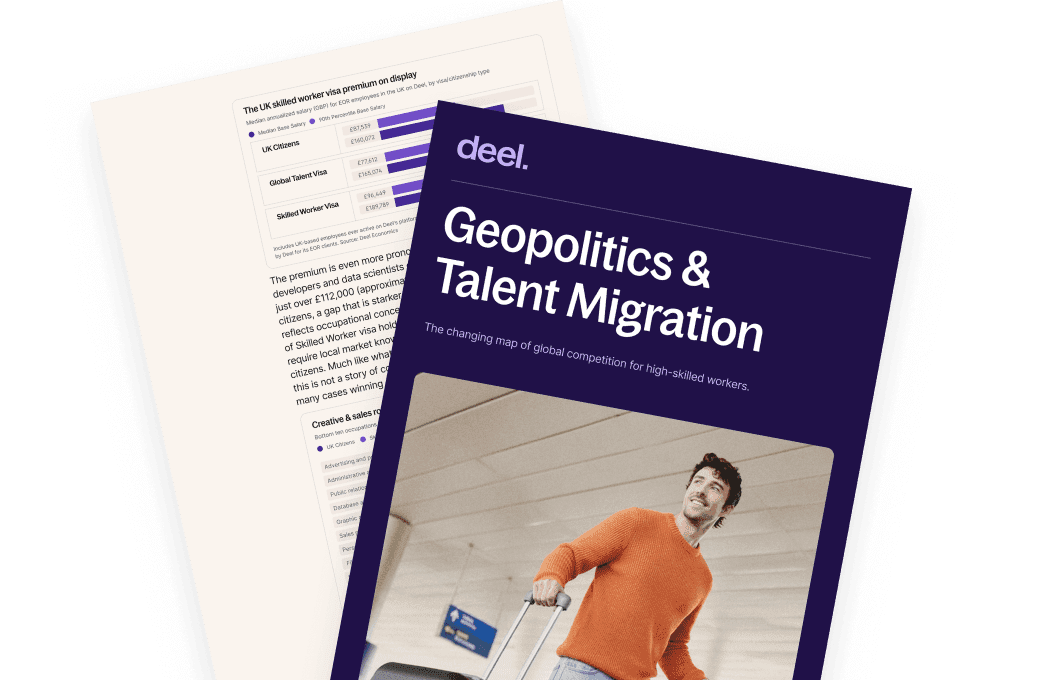
The map of global competition for high-skilled workers is being redrawn. Deel's 2026 report documents how governments are responding to the US H-1B $100,000 supplemental fee—and what it means for every company building a global mobility strategy.
About this report
In September 2025, the US raised the cost of sponsoring international talent by $100,000 per H-1B petition. Within months, Canada committed $1.7 billion to attract the workers the US was pricing out. China launched its first sponsor-free STEM visa. The UK moved to eliminate fees for top-tier university graduates.
This isn't a coincidence. Governments now treat high-skilled immigration as industrial policy—the same way they treat semiconductors or critical minerals. The countries that understood this first are capturing not just talent, but the venture capital, tax revenue, and job creation that comes with it.
Deel hires, pays, and moves workers across 150+ countries for 40,000 companies, and processed more than 6,000 visa cases through its own immigration team in 2025. This report draws on that real-time data to show where talent is going, what it earns, and what breaks down when global mobility infrastructure isn't in place.
What this report covers
- How the US H-1B fee triggered a global policy divergence—and which countries are winning
- Salary data from Deel's platform showing visa holders out-earn local workers by 10–40% across the US, UK, and UAE
- Why processing speed now determines whether companies win or lose the hire
- The operational and financial cost of fragmented immigration systems
- What good global mobility strategy looks like—for companies and governments
Who should read this
CEOs and executive teams making decisions about where to expand and how to compete for talent in markets that are moving fast.
People leaders and CHROs trying to understand why hiring is getting harder in some markets and easier in others.
Finance and operations leaders who need to quantify the cost of immigration complexity—from delayed start dates to lost candidates.
Policymakers and economists who want real hiring flow data, not modeled estimates.
Webinar: Global talent is moving. Is your mobility strategy?
Join Deel's policy, economics, and immigration experts on June 11 for a live walkthrough of the report. See what it takes to separate companies that can adapt to changing immigration and migration rules from those that scramble.
FAQs
What is global mobility strategy and why does it matter now?
Global mobility strategy is how companies plan, manage, and execute the movement of workers across borders—covering visa sponsorship, work permit compliance, relocation, and crisis response. It matters more now because the policy environment is changing faster than most companies can track.
Governments are actively competing for the same high-skilled workers, and companies without a coherent global mobility strategy are losing candidates to markets with faster, cheaper pathways.
Which countries are winning the competition for high-skilled workers?
The US is pursuing a high-selectivity strategy, using the $100,000 H-1B fee to concentrate sponsorship on the highest-wage roles. Most other advanced economies are competing on access and speed.
Canada launched an accelerated pathway for H-1B holders and committed $1.7 billion to a new talent initiative. Germany shortened the path to permanent residency to 21 months. The UAE added a dedicated AI-specialist Golden Visa category in December 2025.
Deel's data shows where workers are actually moving—and the salary premiums they command when they get there.
How does immigration processing speed affect hiring outcomes?
Processing delays are a chronic business cost that most executives underestimate. A two-month processing gap in a competitive market often ends the hire entirely, as candidates take faster offers elsewhere.
Canada and the UK have moved to digital-first immigration systems that are faster and more predictable. Paper-based systems in the Netherlands, Italy, and parts of the US create unpredictable timelines that companies increasingly factor into expansion decisions.
How does Deel help companies build global mobility infrastructure?
Deel Mobility manages visa and work permit applications, compliance tracking, and relocation support across 100+ countries, connecting directly to your HRIS to reduce manual handoffs and keep workforce data in sync. It handles both entity-sponsored and EOR-sponsored work authorizations. Automation handles document preparation and surfaces compliance alerts before deadlines become problems—so HR teams can focus on hiring rather than chasing case updates across inboxes.
What is crisis mobility and why should executives care?
Crisis mobility is the ability to locate, support, and relocate employees rapidly when geopolitical events require it.
In February 2026, Deel coordinated the emergency relocation of hundreds of employees stranded in the Middle East following military strikes—getting nearly everyone home within a week.
The companies that managed situations like this well had one thing in common: infrastructure already in place. Real-time visibility into where every worker is, direct access to in-country experts, and rapid relocation workflows aren't back-office features. They're operational necessities for any globally distributed company.
Should companies rethink US-centric hiring pipelines in 2026?
For many companies, the economics have shifted. The $100,000 H-1B supplemental fee, combined with legal costs and the wage-weighted lottery introduced in February 2026, can push a single international hire well past $106,000 before salary. That math disadvantages startups and mid-sized firms against large enterprises.
Deel's data shows that companies competing for international talent are competing on quality, not cost—and an increasing number are building hiring pipelines across multiple markets rather than depending on a single visa pathway.