
Guide
Contingent Staffing: A Guide to Strategy, Compliance, and Workforce Risk
Employer of record
Global expansion
Contractor management
Get the resource for free
Independent contractors, temporary workers, gig workers, and statement-of-work consultants give staffing agencies and enterprise workforce teams the flexibility to scale quickly, access specialized skills, and support clients' evolving needs — without the overhead of full-time employees.
But managing a contingent workforce also introduces serious compliance risks: worker misclassification, non-compliance with local labor laws, fragmented vendor management systems, and data scattered across multiple platforms can quickly erode the cost and efficiency gains that make contingent labor attractive in the first place.
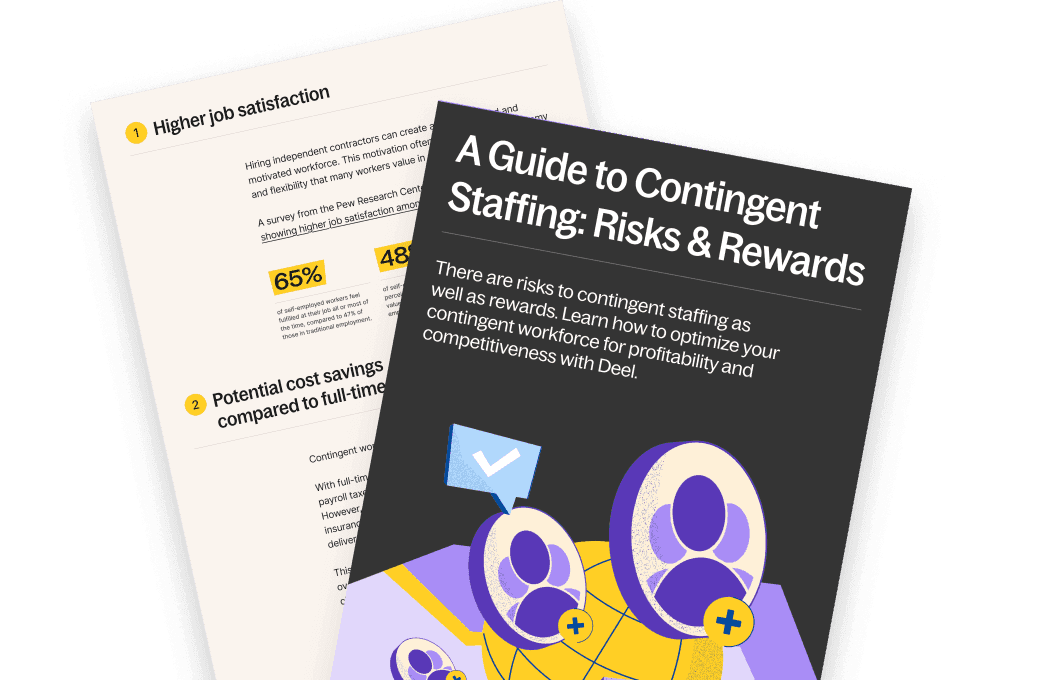
This guide equips staffing agencies and workforce strategy teams with the insight they need to build a contingent workforce program that maximizes the rewards of contingent labor while reducing risks — with practical frameworks for ensuring compliance, centralizing data, and managing both contingent and full-time employees from a single platform.
What this guide covers
- What contingent staffing is and how to choose between independent contractors and temporary EOR employees — including the key differences in worker classification, control, and compliance obligations
- The rewards of hiring contingent workers: cost efficiency, workforce agility, access to specialized skills, and the ability to expand into global labor markets without permanent employment commitments
- The risks of managing a contingent workforce: worker misclassification, non-compliance with local labor laws, intellectual property exposure, workplace injury liability, and data security risks
- How to reduce risks through proper worker classification, country-specific compliant contracts, and a centralized approach to contingent workforce management that eliminates the overhead of multiple vendors
- How to integrate vendor management systems (VMS) with broader workforce data to track performance, manage risk, and eliminate operational inefficiencies caused by fragmented systems
- How Deel enables staffing agencies to manage EOR employees and independent contractors in 150+ countries from one platform — including payroll, compliance, white-label solutions, and client reporting
Who will benefit
- Staffing agency leaders building contingent workforce solutions for clients and looking to expand coverage, reduce compliance risks, and improve margins through centralization
- HR and workforce strategy teams managing blended labor models that combine contingent labor and full-time employees across multiple jurisdictions
- Talent acquisition professionals hiring contingent workers or gig workers and navigating worker classification requirements across different regions
- Operations leaders implementing or optimizing vendor management systems (VMS) to improve oversight and reduce the cost of managing multiple staffing vendors
- Workforce planners designing a contingent workforce program that scales with client demand while maintaining governance and compliance
FAQs
What is contingent staffing and how does it differ from hiring full-time employees?
Contingent staffing refers to engaging non-permanent workers — including independent contractors, gig workers, temporary workers, and statement-of-work consultants — on a project, seasonal, or short-term basis.
Unlike full-time employees, independent contractors manage their own taxes, benefits, and work processes and operate with minimal direction from the hiring entity. EOR employees, by contrast, are legally employed through an employer of record, receive statutory benefits, and are covered by local labor laws. The right model depends on the nature of the work, the level of control required, and the compliance requirements of the worker's jurisdiction.
What are the biggest compliance risks when managing a contingent workforce?
The two primary compliance risks in any contingent workforce program are worker misclassification and co-employment. Misclassification occurs when independent contractors are treated as employees — giving the hiring entity control over how, when, and where work is performed in a way that contradicts independent contractor status under local labor law. This can result in back taxes, penalties, and legal liability.
Co-employment risk arises when a company exercises too much control over contingent workers engaged through a staffing agency, potentially creating shared legal liability for benefits, wage and hour compliance, and employment protections. Regular audits, clear contractual boundaries, and a centralized compliance platform are essential to manage risk effectively.
How does worker misclassification affect staffing agencies and their clients?
When a worker is misclassified as an independent contractor rather than an employee, the consequences can fall on both the staffing agency and the client as de facto employers. These include liability for unpaid employment taxes, back wages, and statutory benefits; fines and penalties from tax authorities and labor departments; and reputational damage that can affect client relationships and future contracts.
Because worker classification rules vary significantly from country to country, the risk is compounded when managing a global contingent workforce. What constitutes an independent contractor in one jurisdiction may be considered employment in another — making country-specific compliance expertise essential.
What role do vendor management systems (VMS) play in contingent workforce management?
Vendor management systems help organizations manage staffing agencies, track contingent labor spend, and maintain compliance documentation across their contingent workforce program. However, when VMS platforms operate in isolation from broader HR and payroll systems, they can create data silos, operational inefficiencies, and gaps in performance tracking that undermine the governance and cost control a contingent workforce program is designed to deliver.
Integrating VMS with a centralized people platform — one that manages both independent contractors and EOR employees — gives staffing agencies and enterprise teams a unified view of their contingent workforce, with accurate reporting, compliant contracts, and consolidated payments across all worker types.
When should a staffing agency use EOR employees instead of independent contractors?
EOR employees are the right choice when there's a need for greater control over how, when, and where work is performed; when compliance risks are high and misclassification exposure needs to be minimized; or when the role involves a longer, non-permanent engagement where worker retention and loyalty are important.
Independent contractors are better suited to short-term projects with clear deliverables, minimal oversight, and task-based client demands. Deel helps staffing agencies assess the correct classification for each worker before any engagement begins, drafting locally compliant contracts and assuming full liability through its Contractor of Record service in the event of a misclassification claim.
How does Deel help staffing agencies reduce risks when hiring contingent workers?
Deel provides a single platform for managing both independent contractors and EOR employees across 150+ countries, eliminating the cost and compliance inconsistency of managing multiple vendors. It handles worker classification assessments, locally compliant contract generation, payroll and payments, IP agreements, and background checks — all in one place.
For staffing agencies, Deel also offers white-label solutions that allow agencies to deliver these services under their own brand, alongside API integration with existing tools and a dedicated support team of tax and legal experts to ensure contingent workforce compliance across every jurisdiction.