
Guide
Buyer's Guide to Global Payroll for Enterprises
Global payroll
Get the resource for free
Managing a global workforce involves navigating the friction between rapid international expansion and the rigid reality of local labor laws. When your team spans multiple continents, staying on top of payroll compliance feels like chasing a moving target. Coordination with regional teams becomes a headache, and juggling a fragmented patchwork of local providers prevents scalability and accurate, data-driven business decisions.
The stakes for enterprise organizations are exceptionally high. A single calculation error or a missed regulatory update doesn't just result in a frustrated employee; it can trigger significant legal repercussions, tax penalties, and lasting damage to your corporate reputation.
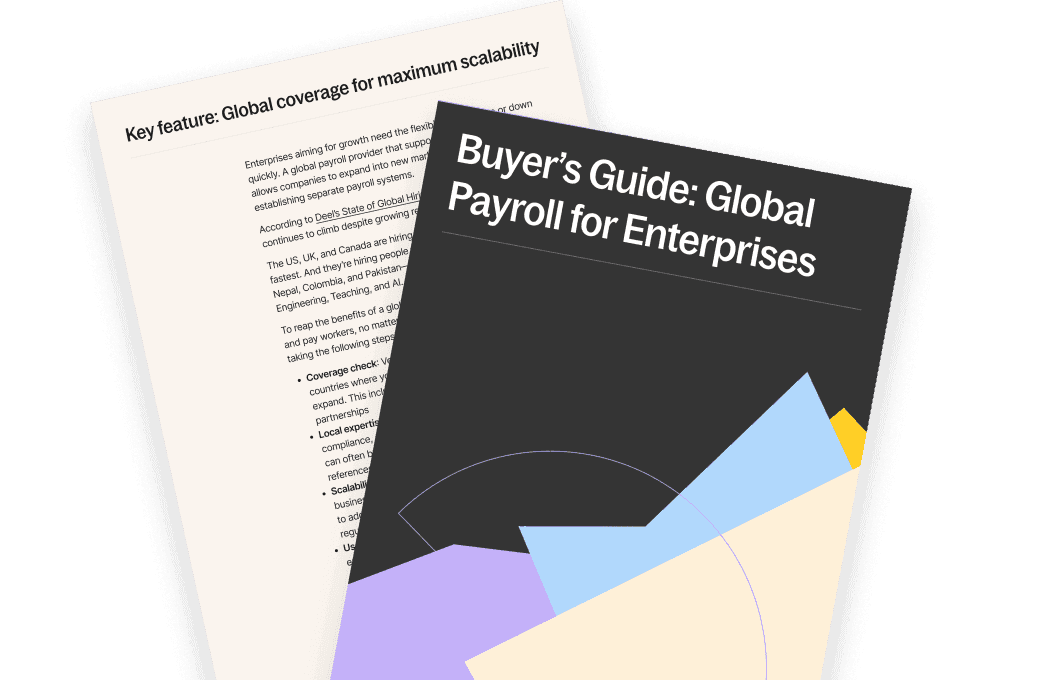
This is why we created the Buyer’s Guide to Global Payroll—a clear, strategic framework designed for finance, procurement, and HR leaders who need to standardize global payroll operations.
Whether you are consolidating existing entities or entering new markets, this guide helps you move from manual, high-risk processes to a streamlined global strategy.
Guide overview
This resource is more than a simple checklist. It is a comprehensive manual for future-proofing your global operations. Inside, you will find:
The true value of a centralized payment system for reducing costs and administrative overhead
A deep dive into the advantages of built-in, automated compliance
How to achieve payroll flexibility to pay direct employees, EOR workers, and contractors in one system
Evaluation criteria for global coverage and scalability to ensure your provider grows with you
A comprehensive checklist covering features, services, and security standards
A vendor comparison between Deel, ADP, Dayforce, and Cloudpay to help you distinguish between fragmented suites and unified platforms
Who is this guide for?
We designed this framework specifically for those responsible for the health and compliance of large-scale global organizations:
Finance Directors and CFOs looking to unify decentralized data and gain real-time visibility into global people spend
HR Leaders in enterprise companies who need a single source of truth for every worker type across multiple countries
Procurement and Legal Teams tasked with vetting providers for ISO 27001, GDPR, and SOC2 compliance
Global Operations Managers struggling to coordinate multiple regional vendors and experiencing unreliable customer support
How to leverage this guide to find a global payroll solution
Choosing a global payroll provider is a high-impact decision that requires alignment across several departments. This guide is structured to facilitate that decision-making process through three key phases:
Phase 1: Discovery
Before considering different payroll providers, you must understand key features that make up an enterprise-level solution. This guide outlines key features and how they benefit your business, so you know exactly what to look for.
Phase 2: Evaluation and feature mapping
Our guide includes a payroll features checklist to guide you through your evaluation. This includes checking for real-time reporting across regions, self-service capabilities, supported payment methods, GDPR compliance, and more.
Phase 3: Vendor comparison and selection
We’ve also outlined a vendor comparison between Deel and other global payroll solutions to help you make the best decision for your business. We compare vendors based on model, delivery, coverage, implementation, integrations, payments, user experience, and pricing.
Proven success in global payroll consolidation
Enterprise organizations frequently find that moving to a unified system is the only way to achieve true scalability. For example, Boston Consulting Group (BCG) faced the challenge of managing payroll across six countries in Southeast Asia using four different payroll vendors. By moving to a multinational solution, they were able to standardize payroll processes with a centralized, efficient system.
We have a call every week with the IT and integration team and every two weeks with the account manager. They are very proactive whenever we have questions—and not only about the payroll.
—Rajes Rajamorganan,
SEA-payroll manager, BCG
Take the next step toward global payroll standardization
Building a global payroll strategy with the right framework reduces manual overhead and increases scalability. It lets you focus on what matters most: growing your business and supporting your people.
Ready to see how a unified platform can transform your operations?
Download the Buyer’s Guide to Global Payroll today
FAQs
What are the main challenges of managing payroll for a global enterprise?
Enterprises typically struggle with decentralized data, lack of standardization, and the inefficiency of managing multiple local providers. This often leads to slow response times from support and an increased risk of payroll errors or late payments. A unified global payroll solution solves this by consolidating all worker types and countries into one platform, providing a single source of truth for finance and HR teams.
How does a global payroll solution ensure compliance in multiple jurisdictions?
A robust solution provides ongoing compliance monitoring and localized contracts that are regularly reviewed by legal experts. It should automatically collect and manage compliance documentation for each country to build a clear audit trail. This reduces the risk of legal repercussions, fines, and penalties while ensuring employees receive the mandatory benefits they are entitled to based on their specific location.
What is the difference between an aggregator and a unified global payroll provider?
Many traditional providers use a "partner-run" or fragmented model where they outsource payroll processing to local partners in each country. This can lead to inconsistent data and slower processing times. A unified provider like Deel uses its own in-house infrastructure and expertise to deliver a consistent experience, real-time accuracy, and faster implementation times—often ranging from 10 days to two months rather than the 6–12 months typical of legacy systems.
Why is multi-currency support critical for international teams?
An international team needs the infrastructure to receive payments quickly and accurately in their preferred local currency. A global payroll system must handle accurate conversions using up-to-date exchange rates and manage various payment methods—from bank transfers to digital wallets. This eliminates currency conversion hassles for the employer and ensures fair compensation for the employee.
What security standards should an enterprise payroll provider meet?
When handling sensitive employee data and millions of dollars in payments, enterprise-grade security is non-negotiable. You should look for providers that are SOC2 compliant, ISO 27001 certified, and GDPR compliant. They should also offer proactive security audit logs, 24/7 system monitoring, and single sign-on (SSO) integration to ensure data integrity across your global operations.